

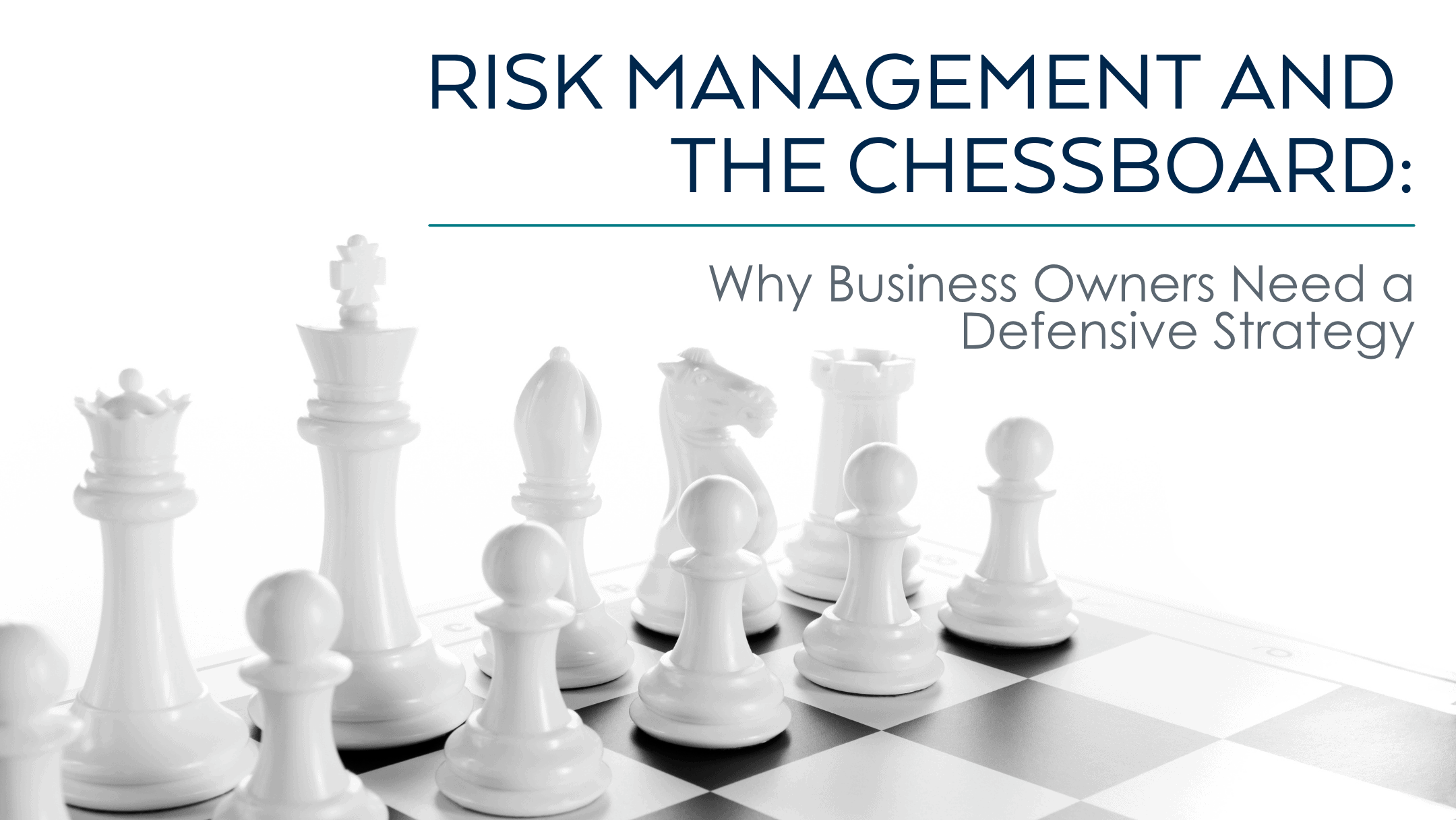
Risk Management and the Chessboard: Why Business Owners Need a Defensive Strategy
By: Mariam Safeh, Director of Insurance
Every business owner understands the importance of growth. Building revenue. Hiring the right people. Expanding services. Strengthening client relationships. Creating momentum.
Most of the conversations around business success focus on offense. How to gain market share. How to increase profitability. How to outpace competitors. There is nothing wrong with that approach. Growth matters. But experienced leaders understand that businesses are often disrupted by the risks they did not prepare for.
In chess, a player can spend an entire game creating opportunities, controlling space, and advancing pieces across the board. Yet many games are ultimately lost because of a position that was left exposed. An overlooked vulnerability. A piece that was left unprotected. A threat that seemed unlikely until it suddenly became unavoidable.
Business ownership works much the same way. But before discussing insurance, succession planning, or business continuity, consider a simple question: Would your business survive the first 90 days if you suddenly could not work?
Who would make critical decisions?
How would employees be paid?
Would key clients remain confident?
Would revenue continue to flow?
For many closely held businesses, the owner’s absence creates challenges almost immediately. Yet disability planning is often delayed until a health event occurs, a diagnosis is received, or insurance coverage becomes difficult or impossible to obtain. Risk management is most effective when decisions are made while options are still available. That is why disability planning is more than an insurance conversation, it is a business continuity conversation.
One of the most overlooked areas of business risk management is preparing for the possibility that an owner becomes disabled and is temporarily or permanently unable to operate at full capacity.
While many business owners carry property coverage, liability protection, and other forms of insurance, disability planning is often pushed to the side. The assumption is understandable. Owners are focused on serving clients, leading teams, and managing daily operations.
The challenge is that life does not always operate according to a business plan.
According to the Centers for Disease Control and Prevention, more than one in four American adults report living with some form of disability. The CDC estimates that approximately 61 million adults in the United States have a disability.
For business owners, the financial implications can extend well beyond personal income.
Three Risk Management Questions Every Business Owner Should Be Able to Answer
Regardless of industry, ownership structure, or company size, every business owner should be able to answer three questions:
- How long could the business operate without me?
- What financial resources would be available during that period?
- Who makes critical decisions if I am unavailable?
The answers often reveal whether a business has a continuity strategy or simply an assumption that things will work themselves out.
The question is not whether a disability will occur. The question is whether the business is prepared if it does. Most business owners can explain exactly what would happen if a server failed, a key client left, or a piece of equipment broke. Far fewer can explain what happens if the owner cannot work for six months. Yet for many businesses, that may be the more consequential risk.
When the Business Depends on the Owner
Many closely held businesses are deeply connected to the owner’s leadership and involvement.
The owner may be responsible for strategic decisions, key client relationships, sales leadership, vendor negotiations, hiring decisions, or overall operational oversight.
When that individual suddenly becomes unable to work, even for a limited period, the impact can be significant.
Business continuity challenges can emerge quickly, including:
- Delays in decision-making
- Client relationship disruptions
- Reduced revenue generation
- Cash flow pressure
- Increased workload for remaining leadership
- Unplanned succession discussions
- Employee uncertainty
The issue is rarely a lack of preparation in other areas. In many cases, owners have spent years creating systems, refining processes, and building successful organizations.
What is often missing is a strategy for preserving stability if the person guiding those systems cannot actively participate in the business.
Disability Risk Is More Common Than Many People Realize
Many individuals associate disability with catastrophic injuries or permanent medical conditions.
In reality, disability can arise from a wide range of circumstances, including illness, surgery, chronic health conditions, accidents, or recovery periods that limit an individual’s ability to perform their occupational responsibilities.
The conversation is not simply about whether a disability occurs. The conversation should be more about how prepared a business is if a disability DOES occur.
One of the challenges with disability planning is timing. Coverage is generally easier to obtain while an individual is healthy and actively working. Waiting until a diagnosis, injury, or medical condition develops may limit available options or make coverage unavailable altogether. By the time many business owners recognize the need for protection, some of them most effective planning opportunities may no longer be available.
Research from LIMRA and Life Happens found that nearly half of U.S. adults believe they need some form of disability insurance, yet ownership rates remain significantly lower. The study found that 46 percent of Americans believe they need disability coverage, while fewer than one in five report having it.
For business owners, that protection gap can create challenges that affect far more than personal finances.
Risk Management Creates Options
One of the primary goals of risk management is preserving flexibility.
When unexpected events occur, leaders generally make better decisions when they have time, resources, and options available.
When no contingency plan exists, decisions are often driven by urgency rather than strategy.
Business disability planning may help create additional flexibility by providing resources that support continuity during a period of disruption.
Depending on the structure and design of coverage, disability planning strategies may help address:
- Personal income replacement
- Business overhead expenses
- Funding for operational continuity
- Buy-sell agreement funding considerations
- Succession planning needs
- Family financial stability
The American Council of Life Insurers notes that certain disability insurance strategies may provide protection for key employees or business owners, helping businesses manage the financial consequences of a sudden loss of productivity or leadership capacity.
Some business-focused disability policies are specifically designed to help cover operating expenses such as rent, utilities, employee compensation, and other ongoing obligations during periods when an owner is unable to work.
The specific structure of any strategy should always be evaluated within the context of the business owner’s goals, financial position, ownership structure, and overall risk profile.
The Relationship Between Disability Planning and Business Continuity
Many business owners spend considerable time discussing growth strategies. Far fewer spend time discussing continuity strategies.
A comprehensive business continuity plan often includes considerations such as succession planning, key-person risk, operational contingencies, liquidity planning, and insurance reviews.
Disability planning frequently intersects with each of these areas.
Questions worth evaluating may include:
- Who is authorized to make critical decisions if the owner is unavailable?
- How long could the business maintain operations without the owner’s active involvement?
- Are key client relationships concentrated with one individual?
- Does the company have adequate cash reserves for an extended disruption?
- Are buy-sell agreements properly funded?
- Have family members or business partners discussed contingency plans?
Addressing these questions does not guarantee that future challenges can be avoided. It can help ensure that future decisions are made thoughtfully rather than reactively.
Strong Leadership Includes Defensive Planning
The strongest business leaders understand that preparation is part of leadership.
They recognize that protecting employees, clients, business partners, and family members requires more than focusing on growth opportunities.
It requires identifying risks before they become emergencies.
In chess, successful players do not wait until their king is exposed to begin thinking about defense.
They strengthen their position while they still control the board.
Business owners can benefit from a similar mindset.
A thoughtful disability insurance and risk management strategy may help provide stability during uncertain periods and create greater confidence in the long-term sustainability of the business.
Final Thoughts
Every business owner faces risks that cannot be fully predicted. Markets change. Industries evolve. Health events occur. Circumstances shift. While no planning strategy can eliminate uncertainty, proactive risk management can help reduce its impact.
Disability insurance planning is more than a personal financial discussion. For many business owners, it is a business continuity discussion, a leadership discussion, and a long-term planning discussion.
At Spartan Wealth Management, we believe comprehensive planning means evaluating both opportunities and vulnerabilities. Growth is important. Protection matters too.
The goal is not to predict every challenge, the goal is to ensure that when challenges arise, the business has options. Growth creates opportunity, but protection preserves it.
Sources
Centers for Disease Control and Prevention (CDC). “Prevalence of Disabilities and Health Care Access by Disability Status and Type Among Adults.” Available at: https://www.cdc.gov/disability-and-health/articles-documents/disabilities-health-care-access.html
Centers for Disease Control and Prevention (CDC). “Prevalence of Disability and Disability Types by Urban-Rural County Classification.” Available at: https://www.cdc.gov/disability-and-health/articles-documents/disability-prevalence.html
Centers for Disease Control and Prevention (CDC). “Disability Impacts All of Us.” Available at: https://www.cdc.gov/disability-and-health/articles-documents/disability-impacts-all-of-us-infographic.html
LIMRA and Life Happens. “Disability Insurance Awareness Month: Protecting Your Paycheck and Your Future.” Available at: https://www.limra.com/en/newsroom/industry-trends/2024/disability-insurance-awareness-month-protecting-your-paycheck-and-your-future/
LIMRA and Life Happens. “Disability Insurance Awareness Month: Is Your Income Protected?” Available at: https://www.limra.com/en/newsroom/industry-trends/2025/disability-insurance-awareness-month-is-your-income-protected/
American Council of Life Insurers (ACLI). “Household Ownership and Access to Life Insurance and Disability Insurance.” Available at: https://www.acli.com
Guardian Life Insurance Company. “Keep Your Business Sailing Smoothly.” Available at: https://www.guardianlife.com
Disclosures:
This material contains only general descriptions and is not a solicitation to sell any insurance product or security, nor is it intended as any financial or tax advice. For information about specific insurance needs or situations, contact your insurance agent. This article is intended to assist in educating you about insurance generally and not to provide personal service. They may not take into account your personal characteristics such as budget, assets, risk tolerance, family situation or activities which may affect the type of insurance that would be right for you. In addition, state insurance laws and insurance underwriting rules may affect available coverage and its costs. Guarantees are based on the claims paying ability of the issuing company. If you need more information or would like personal advice you should consult an insurance professional. You may also visit your state’s insurance department for more information.
Advisors associated with Spartan Wealth Management may be either (1) registered representatives with, and securities offered through LPL Financial, Member FINRA/SIPC, and investment advisor representatives of Spartan Wealth Management; or (2) solely investment advisor representatives of Spartan Wealth Management, and not affiliated with LPL Financial. Investment advice offered through Spartan Wealth Management, a registered investment advisor and separate entity from LPL Financial. Registration does not constitute an endorsement from the commission, nor does it imply a certain level of skill or ability.