


What impact does the housing market have on the economy and financial planning?
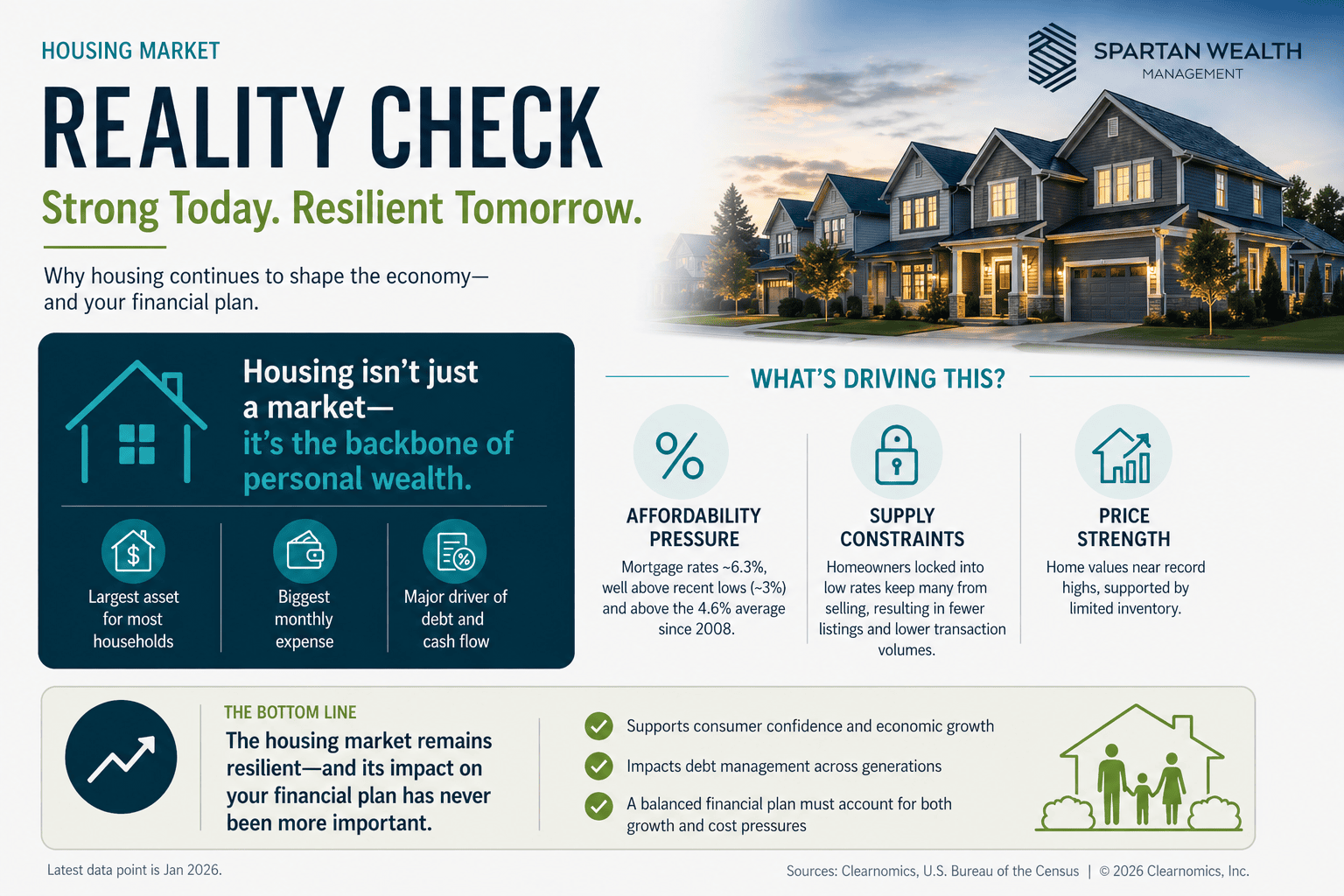
Housing is deeply connected to financial planning since, for most families, a home is their largest asset, biggest monthly expense, and primary source of debt. Understanding how housing affects the economy can help inform long-term financial decisions.
Here are some key points to consider:
• Home prices remain historically strong, with the Case-Shiller index around record levels, far above the 2006 housing bubble peak. While each local housing market is different, these national averages can help us understand the impact on the economy, especially as interest rates remain high.
• The 30-year fixed mortgage rate is around 6.3%, well above the 3% lows seen in 2020-2021 and above the 4.6% average since 2008. This makes homeownership more expensive than just a few years ago, and also means that some homeowners are “locked in” since buying a new home would mean giving up their existing low rates. This is one reason the supply and transaction volumes of existing homes remain lower than many would like.
• It’s no surprise that real estate is one of the largest assets for most households, across all generations. Older generations, however, have had time to pay off their mortgages, and may even have multiple properties. For younger generations, mortgage debt is one of the largest sources of monthly payments, raising their debt service levels. So, across all generations, how investors manage these assets and debts is an important component of financial planning.
• Still, high home values support consumer confidence and spending, a factor that is sometimes referred to as a “wealth effect.” On the other hand, elevated housing costs have kept the “shelter” component of inflation stubbornly high, making it harder for inflation to return to the Fed’s 2% target.
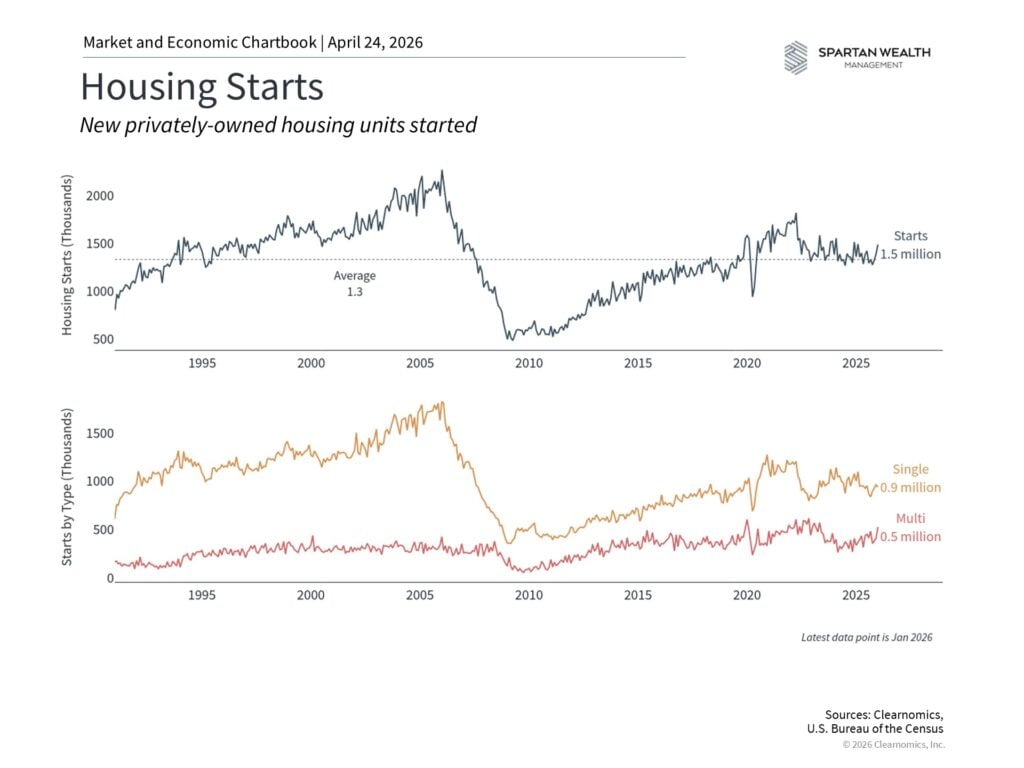
The included chart tracks housing starts, a measure of new construction activity. Activity has picked up in response to high home prices and reduced inventories, but is still well below their post-pandemic peak and historic highs.
Despite significant volatility in financial markets this year, the housing market remains relatively strong. Keeping a long-term perspective and understanding your full financial picture remains the foundation of sound financial planning.
Disclosure:
Advisors associated with Spartan Wealth Management may be either (1) registered representatives with, and securities offered through LPL Financial, Member FINRA/SIPC, and investment advisor representatives of Spartan Wealth Management; or (2) solely investment advisor representatives of Spartan Wealth Management, and not affiliated with
LPL Financial. Investment advice offered through Spartan Wealth Management, a registered investment advisor and separate entity from LPL Financial. Registration does not constitute and endorsement by the Commission, nor does it imply a certain level of skill or ability.
This material was prepared by Clearnomics, Inc. The information contained herein has been obtained from sources believed to be reliable, but is not necessarily complete and its accuracy cannot be guaranteed. No representation or warranty, express or implied, is made as to the fairness, accuracy, completeness, or correctness of the information and opinions contained herein. The views and the other information provided are subject to change without notice. All reports posted on or via www.clearnomics.com or any affiliated websites, applications, or services are issued without regard to the specific investment objectives, financial situation, or particular needs of any specific recipient and are not to be construed as a solicitation or an offer to buy or sell any securities or related financial instruments. Past performance is not necessarily a guide to future results. Company fundamentals and earnings may be mentioned occasionally, but should not be construed as a recommendation to buy, sell, or hold the company’s stock. Predictions, forecasts, and estimates for any and all markets should not be construed as recommendations to buy, sell, or hold any security–including mutual funds, futures contracts, and exchange traded funds, or any similar instruments. The text, images, and other materials contained or displayed in this report are proprietary to Clearnomics, Inc. and constitute valuable intellectual property. All unauthorized reproduction or other use of material from Clearnomics, Inc. shall be deemed willful infringement(s) of this copyright and other proprietary and intellectual property rights, including but not limited to, rights of privacy. Clearnomics, Inc. expressly reserves all rights in connection with its intellectual property, including without limitation the right to block the transfer of its products and services and/or to track usage thereof, through electronic tracking technology, and all other lawful means, now known or hereafter devised. Clearnomics, Inc. reserves the right, without further notice, to pursue to the fullest extent allowed by the law any and all criminal and civil remedies for the violation of its rights. There is no guarantee that a diversified portfolio will enhance overall returns or outperform a non-diversified portfolio.