

What does the UAE leaving OPEC mean for oil and consumers?
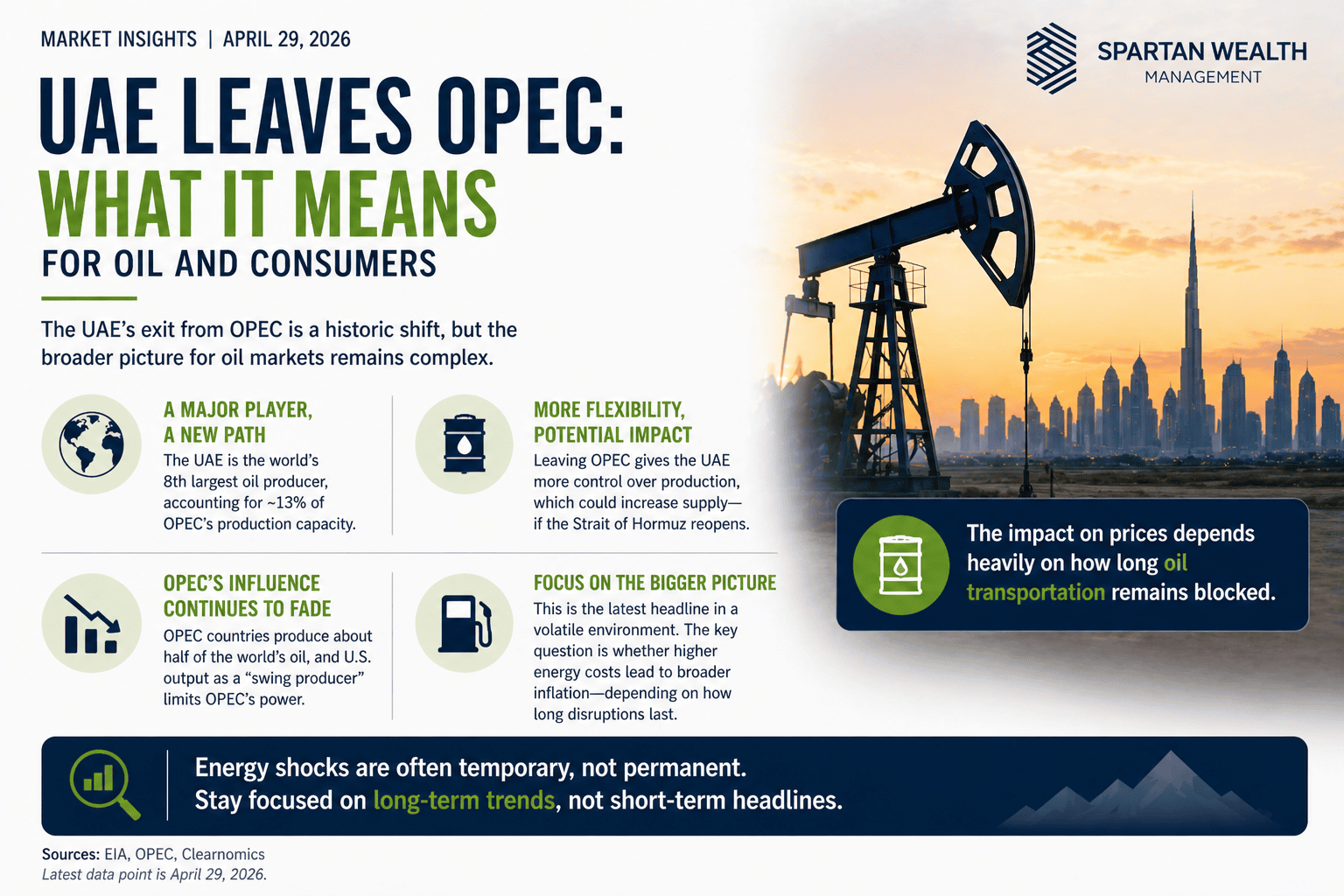
The UAE’s departure is a significant development since it removes about 13% of OPEC’s production capacity and marks the first time a large oil producer has left the group.
Here are some key points to consider:
• The UAE is the eighth largest oil producer in the world, according to the Energy Information Agency and OPEC. They have been moving further away from OPEC over time, and this rift has accelerated due to the war in Iran, which is also an OPEC member country. In fact, Iran has attacked the UAE with missiles and drones during this conflict.
• Leaving OPEC allows the UAE to make its own oil production decisions. In theory, this could increase the supply of oil, helping to relieve supply constraints. Of course, this depends heavily on the Strait of Hormuz reopening so oil transportation bottlenecks can be resolved.
• While OPEC and OPEC+, which includes additional countries such as Russia, are still important groups, they have become less relevant in recent decades. Unlike during the Arab Oil Embargo of the 1970s, OPEC countries now only account for about half of the world’s oil production. Additionally, it has been difficult to enforce production quotas among member countries, since each has an incentive to produce more. The fact that the U.S. is now the largest producer of oil and gas, often referred to as a “swing producer,” also makes OPEC less relevant today.
• The immediate reaction to the UAE’s announcement in the oil market has been limited. Oil had already been above $100 per barrel due to the U.S. rejecting the latest peace plan by Iran.
• For consumers and investors, this is just the latest headline when it comes to volatility in oil prices, the stock market, and inflation. While gas prices at the pump remain high, the most important question is whether higher energy costs will translate into higher costs for other goods and services. This depends entirely on how long oil transportation remains blocked.
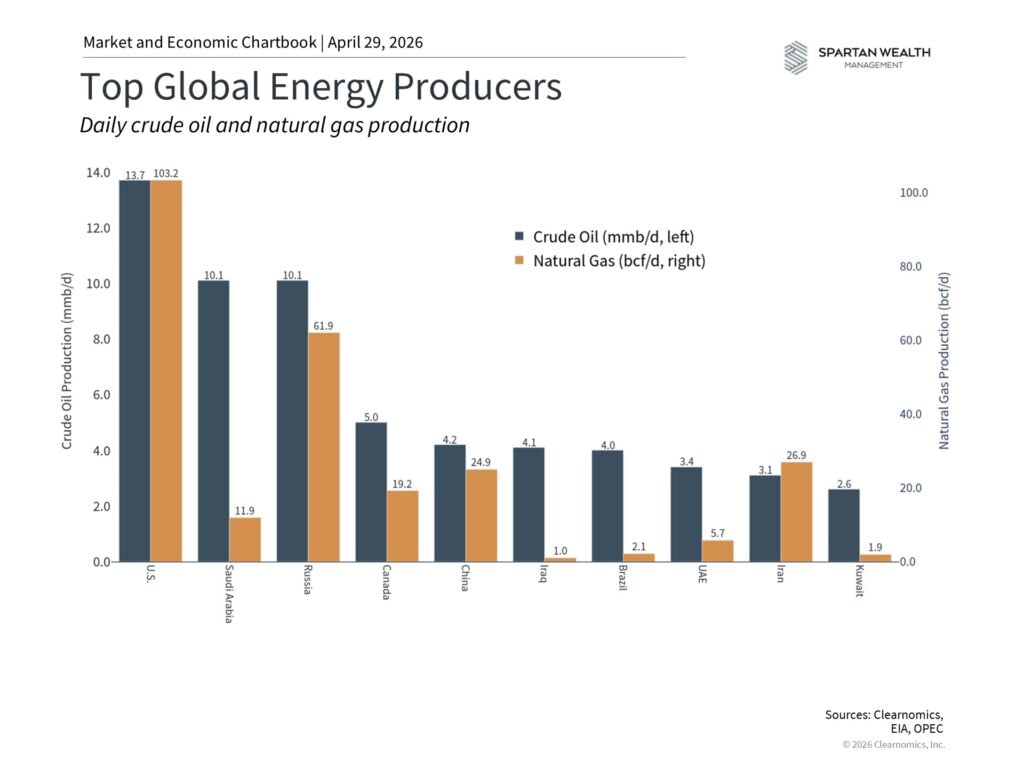
The included chart shows the world’s top oil producers, many of which are OPEC countries. While today’s energy price spike is real, history shows that supply shocks tend to be temporary rather than permanent economic disruptions, and staying focused on long-term trends rather than short-term market events remains the most sound approach for investors.
Disclosure:
Advisors associated with Spartan Wealth Management may be either (1) registered representatives with, and securities offered through LPL Financial, Member FINRA/SIPC, and investment advisor representatives of Spartan Wealth Management; or (2) solely investment advisor representatives of Spartan Wealth Management, and not affiliated with
LPL Financial. Investment advice offered through Spartan Wealth Management, a registered investment advisor and separate entity from LPL Financial. Registration does not constitute and endorsement by the Commission, nor does it imply a certain level of skill or ability.
This material was prepared by Clearnomics, Inc. The information contained herein has been obtained from sources believed to be reliable, but is not necessarily complete and its accuracy cannot be guaranteed. No representation or warranty, express or implied, is made as to the fairness, accuracy, completeness, or correctness of the information and opinions contained herein. The views and the other information provided are subject to change without notice. All reports posted on or via www.clearnomics.com or any affiliated websites, applications, or services are issued without regard to the specific investment objectives, financial situation, or particular needs of any specific recipient and are not to be construed as a solicitation or an offer to buy or sell any securities or related financial instruments. Past performance is not necessarily a guide to future results. Company fundamentals and earnings may be mentioned occasionally, but should not be construed as a recommendation to buy, sell, or hold the company’s stock. Predictions, forecasts, and estimates for any and all markets should not be construed as recommendations to buy, sell, or hold any security–including mutual funds, futures contracts, and exchange traded funds, or any similar instruments. The text, images, and other materials contained or displayed in this report are proprietary to Clearnomics, Inc. and constitute valuable intellectual property. All unauthorized reproduction or other use of material from Clearnomics, Inc. shall be deemed willful infringement(s) of this copyright and other proprietary and intellectual property rights, including but not limited to, rights of privacy. Clearnomics, Inc. expressly reserves all rights in connection with its intellectual property, including without limitation the right to block the transfer of its products and services and/or to track usage thereof, through electronic tracking technology, and all other lawful means, now known or hereafter devised. Clearnomics, Inc. reserves the right, without further notice, to pursue to the fullest extent allowed by the law any and all criminal and civil remedies for the violation of its rights. There is no guarantee that a diversified portfolio will enhance overall returns or outperform a non-diversified portfolio.