


Thanks for your question on recent developments in the private credit market. Private credit refers to loans made by non-bank lenders to companies, often those with lower credit ratings, in exchange for higher interest payments. This market has grown significantly in recent years, making it an important topic for investors to follow.
Here are some key points to consider:
- The latest concerns arose when Blue Owl Capital, a private credit manager, announced it was permanently ending redemption requests for one of its large funds. It also liquidiated $1.4 billion in assets to meet redemption requests from investors wanting to exit its funds. This news rattled confidence in the industry and sparked new questions around the rapid growth of these assets.
- The big picture is that, since 2008, significant lending activity has shifted from traditional banks to “non-depository financial institutions” (NDFIs) such as private credit funds, mortgage companies, insurance companies, online lenders, and more. This has fueled the industry, with many wondering when the growth would either slow or cracks would begin to form.
- There were signs of stress last year when some private companies declared bankruptcy or were accused of fraud. Famously, Jamie Dimon, the CEO of JPMorgan, made a comment that when you find one cockroach, there are likely to be others. Broader signs of stress in private credit include a jump in redemption requests at the end of 2025 and a slowdown in new investments flowing into these funds, which could weigh on future earnings growth for the sector.
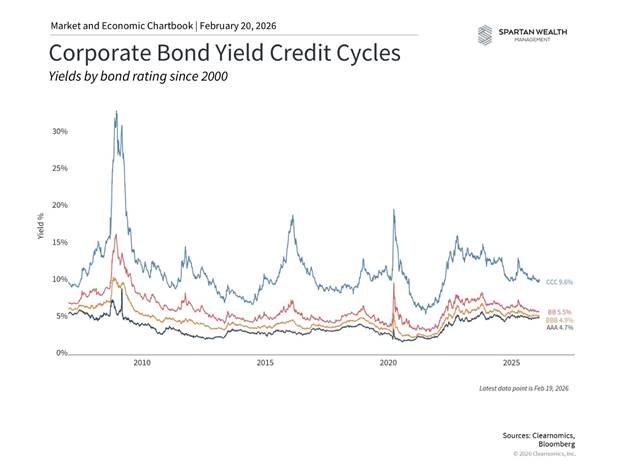
- For long-term investors, public credit and bonds most likely play a larger role in portfolios. So, in contrast to private markets, public credit markets remain healthy, with spreads still quite low. In fact, areas like high yield still offer healthy yields for investors seeking income.
The included chart shows corporate credit yields across credit cycles, helping illustrate how credit conditions in public markets compare to the stress emerging in private credit today.
While short-term turbulence in private credit deserves attention, staying focused on diversification and long-term fundamentals remains the most reliable path to financial success.
Disclosure:
Advisors associated with Spartan Wealth Management may be either (1) registered representatives with, and securities offered through LPL Financial, Member FINRA/SIPC, and investment advisor representatives of Spartan Wealth Management; or (2) solely investment advisor representatives of Spartan Wealth Management, and not affiliated with LPL Financial. Investment advice offered through Spartan Wealth Management, a registered investment advisor and separate entity from LPL Financial.
Information presented is for educational purposes only and does not intend to make an offer or solicitation for the sale or purchase of any securities. Spartan Wealth’s website and its associated links offer news, commentary, and generalized research, not personalized investment advice. Nothing on this website should be interpreted to state or imply that past performance is an indication of future performance. All investments involve risk and unless otherwise stated, are not guaranteed. Be sure to consult with a tax professional before implementing any investment strategy. Investment Advisory Services offered through Spartan Wealth Management, a Registered Investment Advisor. Registration does not constitute an endorsement by the SEC nor does it imply a certain level of skill or training.
The information contained herein has been obtained from sources believed to be reliable, but is not necessarily complete and its accuracy cannot be guaranteed. No representation or warranty, express or implied, is made as to the fairness, accuracy, completeness, or correctness of the information and opinions contained herein. The views and the other information provided are subject to change without notice. All reports posted on or via www.clearnomics.com or any affiliated websites, applications, or services are issued without regard to the specific investment objectives, financial situation, or particular needs of any specific recipient and are not to be construed as a solicitation or an offer to buy or sell any securities or related financial instruments. Past performance is not necessarily a guide to future results. Company fundamentals and earnings may be mentioned occasionally, but should not be construed as a recommendation to buy, sell, or hold the company’s stock. Predictions, forecasts, and estimates for any and all markets should not be construed as recommendations to buy, sell, or hold any security–including mutual funds, futures contracts, and exchange traded funds, or any similar instruments. The text, images, and other materials contained or displayed in this report are proprietary to Clearnomics, Inc. and constitute valuable intellectual property. All unauthorized reproduction or other use of material from Clearnomics, Inc. shall be deemed willful infringement(s) of this copyright and other proprietary and intellectual property rights, including but not limited to, rights of privacy. Clearnomics, Inc. expressly reserves all rights in connection with its intellectual property, including without limitation the right to block the transfer of its products and services and/or to track usage thereof, through electronic tracking technology, and all other lawful means, now known or hereafter devised. Clearnomics, Inc. reserves the right, without further notice, to pursue to the fullest extent allowed by the law any and all criminal and civil remedies for the violation of its rights.