



How has the war in Iran affected the economy?
This is something economists are watching closely since the labor market has weakened considerably over the past year, which has implications for consumer spending, corporate earnings, and Federal Reserve policy decisions.
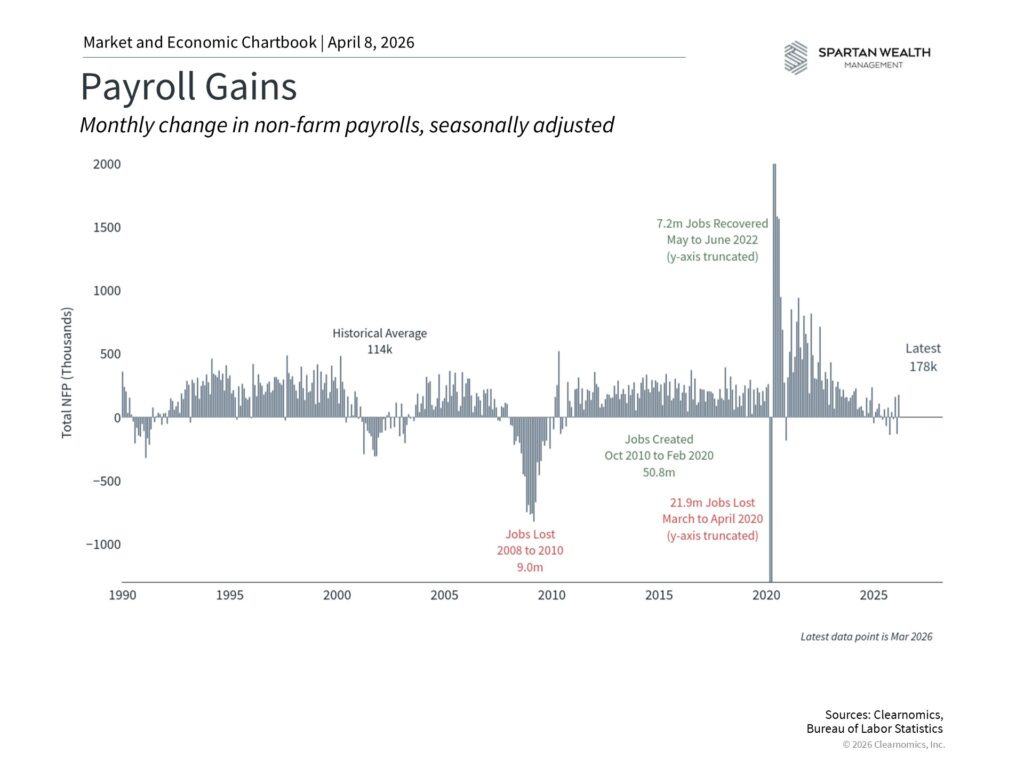
• The U.S. added 178,000 jobs in March, a rebound from a revised loss of 133,000 in February, which was revised down and is worse than previously believed. This means that the economy has averaged only about 15,000 jobs per month over the past six months, a very soft pace.
• The unemployment rate edged down slightly to 4.3%, but this partly reflects a shrinking labor force, as the share of Americans working or looking for work fell to 61.9%, its lowest since fall 2021. About 400,000 workers dropped out of the job market during this period. Immigration and demographics have been important reasons for this trend.
• Wage growth remained modest, with average hourly earnings rising 3.5% over the past year, a slower pace than in recent years, while the average workweek also edged down slightly. Still, this level of wage growth is faster than inflation, on average.
• Investors, economists, and policymakers are weighing these reports carefully. While they are weak by historical standards, the reality is that a slower-growing labor force requires fewer job gains each month. For the Fed especially, this makes it difficult to judge whether the economy needs further support, especially if inflation due to higher oil prices is also a concern.
The included chart shows recent trends in nonfarm payrolls, which helps put the current slowdown in job creation in historical context and illustrates how the labor market has shifted over time.
While near-term economic data can be noisy, long-term investors are best served by staying focused on broader trends and maintaining a well-diversified portfolio that can weather short-term fluctuations.
What does the ceasefire in Iran mean for investors?
The main way that geopolitics affects consumers and businesses is via the energy market. For instance, gasoline and diesel are key inputs for transportation, manufacturing, and everyday consumer spending, so price swings can ripple through the broader economy.
• The national average for regular unleaded gasoline has climbed above $4 per gallon, driven by conflict in Iran and disruptions to the Strait of Hormuz. While this is still below the $5 per gallon seen during the war in Ukraine, it is a jump of over $1 in just about a month. With the recent ceasefire and a drop in oil prices, consumers could begin to see relief at the pump, although this will depend on geopolitical events and may take some time.
• There are direct costs to consumers at the pump as well as indirect ones. Higher fuel costs raise prices across the economy since gasoline and diesel are inputs into transportation, manufacturing, and agriculture. That said, most households can absorb these higher costs without creating too much financial stress, although they do reduce discretionary income and savings. Those households at lower income brackets are hit the hardest.
• The jump in fuel prices, even if it ends up lasting only a couple of months, is expected to push headline inflation higher. Energy is an important component of overall inflation, one that consumers can’t easily avoid. Organizations like the OECD have estimated that U.S. inflation could rise faster than expected in 2026. The IMF’s latest projections show higher prices as well, stating that “‘all roads’ lead to higher prices, slower growth.”
• Rising inflation complicates Federal Reserve decision-making. There was a brief period where the market assigned a greater probability of the Fed hiking rates. At the moment, fed funds futures suggest the Fed could hold rates steady. These swings in expectations due to geopolitics only add to economic uncertainty and make it difficult for businesses to plan beyond the next few months.
• Beyond the war in Iran, the economy has struggled for other reasons, including the weakening labor market. That said, there are positive factors as well. Consumer spending remains healthy and businesses continue to report expanding profits. This has helped to support both stocks and bonds despite geopolitical risks.
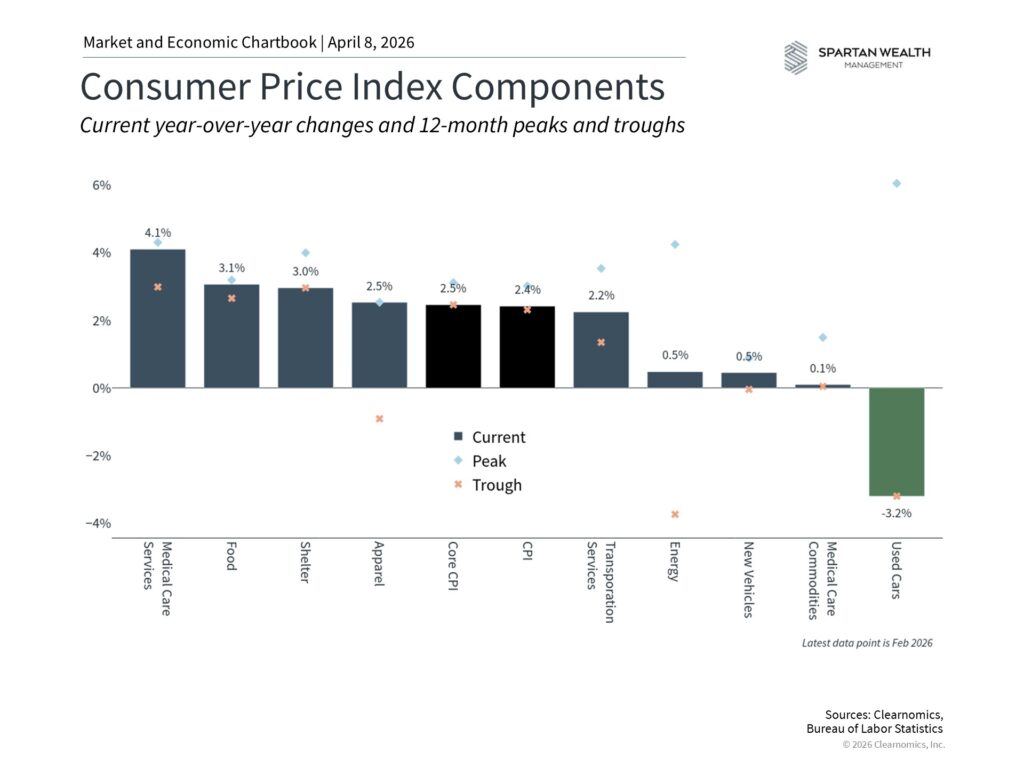
The included chart shows how the Consumer Price Index, a key measure of inflation, is broken down by component. Inflation has been improving over the past few years, but has struggled to fall further in recent months due to both underlying economic trends and higher oil prices.
While short-term energy price spikes can create real challenges, long-term investors are best served by staying focused on broader economic trends and maintaining a well-diversified portfolio rather than reacting to individual market disruptions.
Disclosure:
Advisors associated with Spartan Wealth Management may be either (1) registered representatives with, and securities offered through LPL Financial, Member FINRA/SIPC, and investment advisor representatives of Spartan Wealth Management; or (2) solely investment advisor representatives of Spartan Wealth Management, and not affiliated with LPL Financial. Investment advice offered through Spartan Wealth Management, a registered investment advisor and separate entity from LPL Financial.
This material was prepared by Clearnomics, Inc. The information contained herein has been obtained from sources believed to be reliable, but is not necessarily complete and its accuracy cannot be guaranteed. No representation or warranty, express or implied, is made as to the fairness, accuracy, completeness, or correctness of the information and opinions contained herein. The views and the other information provided are subject to change without notice. All reports posted on or via www.clearnomics.com or any affiliated websites, applications, or services are issued without regard to the specific investment objectives, financial situation, or particular needs of any specific recipient and are not to be construed as a solicitation or an offer to buy or sell any securities or related financial instruments. Past performance is not necessarily a guide to future results. Company fundamentals and earnings may be mentioned occasionally, but should not be construed as a recommendation to buy, sell, or hold the company’s stock. Predictions, forecasts, and estimates for any and all markets should not be construed as recommendations to buy, sell, or hold any security–including mutual funds, futures contracts, and exchange traded funds, or any similar instruments. The text, images, and other materials contained or displayed in this report are proprietary to Clearnomics, Inc. and constitute valuable intellectual property. All unauthorized reproduction or other use of material from Clearnomics, Inc. shall be deemed willful infringement(s) of this copyright and other proprietary and intellectual property rights, including but not limited to, rights of privacy. Clearnomics, Inc. expressly reserves all rights in connection with its intellectual property, including without limitation the right to block the transfer of its products and services and/or to track usage thereof, through electronic tracking technology, and all other lawful means, now known or hereafter devised. Clearnomics, Inc. reserves the right, without further notice, to pursue to the fullest extent allowed by the law any and all criminal and civil remedies for the violation of its rights.