

By: Derek Damian, AIF®
Chief Investment Officer
August 2026 Market Review | The Market’s Job is to Adapt
Why Long-Term Investors Benefit When Markets Process Change Rather Than Fear It
Every month seems to bring a new headline that claims to redefine the investment landscape. One month the conversation centers on artificial intelligence. The next month it shifts to interest rates, inflation, or geopolitical conflict. Before long, another development captures investors’ attention, and the cycle begins again.
July was no exception.
Renewed tensions in the Middle East, rising oil prices, evolving expectations for Federal Reserve policy, and a pullback in many of the companies that have drive much of the market’s recent gains all contributed to a month that tested investor confidence. Yet beneath the headlines, something more important was taking place.
The market was doing exactly what it has always done. It was adapting.
That distinction matters. Markets are designed to process enormous amounts of information every day. New economic data, corporate earnings, policy decisions, and world events are continuously evaluated and reflected in prices. While the headlines often create the impression that uncertainty is something new, uncertainty has always been part of investing. The market’s ability to adapt to changing information is one of its defining characteristics.
For long-term investors, understanding this process can help shift the focus away from short-term reactions and back toward the financial plan that was designed to guide decisions through both calm and turbulent markets.
July’s Headlines Tested Several Parts of the Stock Market
July presented investors with several significant developments. Renewed conflict involving the United States and Iran raised concerns about energy supplies, sending oil prices higher before easing later in the month. Rising energy prices also renewed questions about inflation and the path of future interest rates. The Federal Reserve ultimately left rates unchanged, although policymakers continued to signal that inflation remains an important area of focus.
At the same time, earnings season shifted attention toward some of the market’s largest technology companies. After years of enthusiasm surrounding artificial intelligence, investors began asking a different question. Rather than focusing primarily on how much companies were investing, markets increasingly looked for evidence that those investments would produce sustainable returns and stronger earnings over time.
Neither of these developments should be surprising. Markets continually reassess expectations as new information becomes available. What changes is not the market’s willingness to adapt, but the questions investors are asking at a particular moment.
Leadership Changed, But the Market Continued Working
One of the easiest mistakes investors can make is assuming that when one part of the market struggles, the entire market must be struggling as well.
July offered an excellent reminder that markets are rarely that simple.
Technology companies experienced meaningful weakness as investors reevaluated expectations surrounding artificial intelligence spending. At the same time, several other sectors posted positive returns. Energy benefited from higher oil prices, while Financials, Real Estate, Health Care, and Consumer Staples also finished the month higher. Seven of the eleven sectors within the S&P 500 delivered positive returns during July.
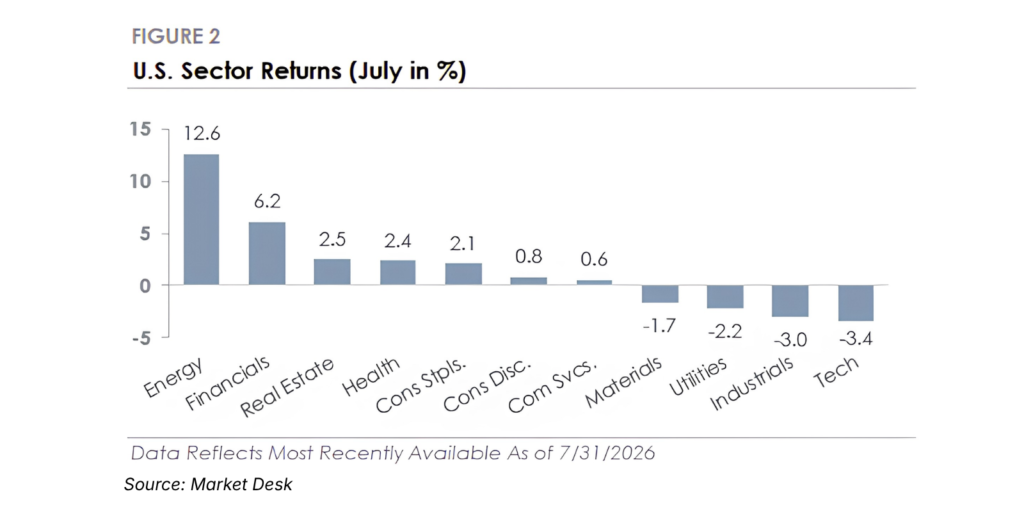
This type of rotation is both common and healthy.
Different sectors respond differently to changes in economic conditions, interest rates, corporate earnings, and investor expectations. Leadership rarely remains concentrated in the same areas indefinitely. As conditions evolve, capital often moves toward industries that appear better positioned for the environment ahead.
That rotation is one reason diversified portfolios remain an important part of long-term investing. While no allocation eliminates risk, diversification helps reduce the need to predict which area of the market will lead next.
Healthy Markets Ask Better Questions
Much of the attention during July centered on artificial intelligence, but perhaps the more meaningful story was how investors evaluated it.
Over the past two years, conversations around AI have focused on growth potential, innovation, and expanding investment. Those themes remain important, but investors have begun placing greater emphasis on profitability, cash flow, and long-term returns on those investments. Companies demonstrating stronger financial results generally fared better than those whose spending significantly outpaced current earnings.
That shift should not necessarily be viewed as a negative development.
Financial markets naturally become more discerning as new technologies mature. Initial excitement often gives way to deeper analysis of execution, operating performance, and long-term business fundamentals. Markets are continually refining expectations rather than simply abandoning promising ideas.
History has shown that many transformative innovations experience periods of enthusiasm, recalibration, and renewed growth. Those phases can feel uncomfortable in the moment, but they are often part of the normal evolution of emerging industries.
“Markets are designed to process uncertainty. Long-term financial plans are designed to withstand it.”
Perspective Changes the Conversation
Looking only at July’s returns might suggest that investors experienced a particularly difficult environment.
Looking at the past year tells a different story.
Despite recent volatility, broad market returns over the previous twelve months remain constructive across many areas of the market. Large-cap value stocks gained more than 31 percent over the past year, while small-cap value and small-cap blend also posted strong returns. Even after July’s pullback, many diversified asset classes continue to reflect positive long-term trends.
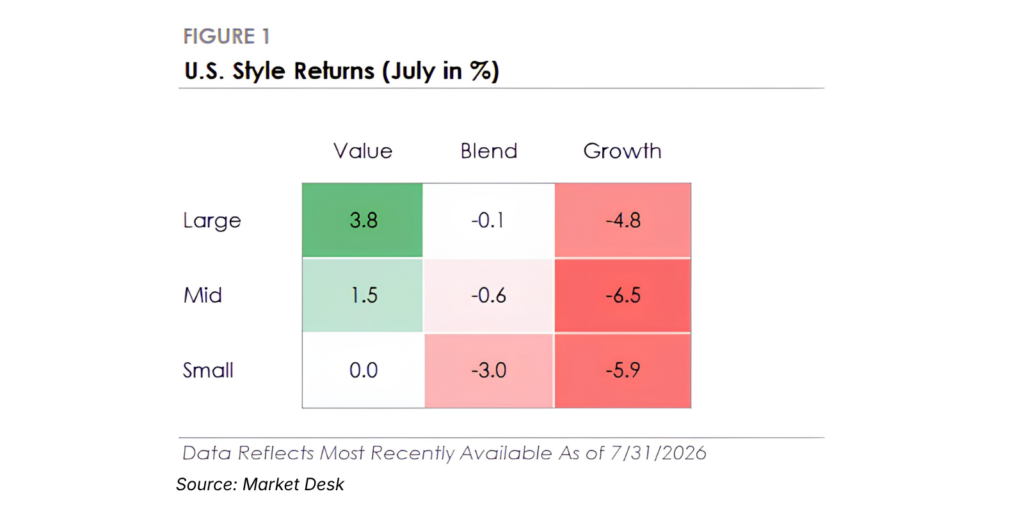
This is an important reminder that time horizon matters.
Short periods often magnify uncertainty because investors naturally focus on recent events. Extending the timeframe frequently provides a clearer perspective on how markets have continued progressing despite periods of volatility along the way.
That does not mean every month will produce positive returns, nor should investors expect markets to move in a straight line. Periods of uncertainty remain an unavoidable part of investing. What history consistently demonstrates is that markets have repeatedly adapted to changing conditions while rewarding patient investors over longer periods.
Stay Focused on the Plan
Every investment environment presents a new set of challenges.
One year investors worry about inflation. Another year they focus on elections, global conflicts, interest rates, or technological disruption. While the specific concerns evolve, uncertainty itself remains remarkably consistent.
That is precisely why a thoughtfully constructed financial plan matters.
Rather than attempting to anticipate every market movement or respond to every headline, a disciplined investment approach provides a framework for making decisions that remain aligned with long-term goals. Diversification, appropriate risk management, and regular portfolio reviews are designed to account for changing market conditions without requiring investors to continually alter course.
July reminded us that markets are remarkably efficient at absorbing new information. Expectations change. Leadership rotates. Prices adjust. Through it all, the market continues doing the work it was designed to do.
Its job is to adapt.
Our job as long-term investors is different. It is to remain focused on the destination, continue evaluating opportunities with discipline, and allow a well-designed investment strategy to work through the changing conditions that every market cycle inevitably brings.
Disclosures:
The opinions voiced in this material are for general information only and are not intended to provide specific advice or recommendations for any individual. All performance referenced is historical and is no guarantee of future results.
The economic forecasts set forth in this material may not develop as predicted and there can be no guarantee that strategies promoted will be successful. Investing involves risk including the loss of principal. There is no guarantee that a diversified portfolio will enhance overall returns or outperform a non-diversified portfolio. Diversification does not protect against market risk.
Advisors associated with Spartan Wealth Management may be either (1) registered representatives with, and securities offered through LPL Financial, Member FINRA/SIPC, and investment advisor representatives of Spartan Wealth Management; or (2) solely investment advisor representatives of Spartan Wealth Management, and not affiliated with LPL Financial. Investment advice offered through Spartan Wealth Management, a registered investment advisor and separate entity from LPL Financial. Registration does not constitute an endorsement from the commission, nor does it imply a certain level of skill or ability.