


Oil is one of those commodities that touches nearly every part of our lives, from the gasoline we put in our cars to the cost of groceries and manufactured goods. Understanding how oil prices affect inflation, consumer spending, and growth is important for any long-term financial plan.
Here are some key points to consider:
- Oil prices have risen sharply due to ongoing conflict in Iran, with Brent crude around $90 per barrel and WTI just below that. The key consideration is the Strait of Hormuz, a crucial waterway that connects the Persian Gulf to the rest of the world. Oil markets have been volatile on news of attacks on oil tankers on the one hand, and commitment by the U.S. to provide safe passage and insurance on the other.
- There are also reports that countries like Kuwait may be cutting production. With the Strait of Hormuz restricted, some countries could run out of storage capacity, requiring them to slow production.
- Oil prices that rise significantly can act like an extra tax on households, since driving and buying goods are everyday necessities. Since consumer spending makes up more than two-thirds of U.S. GDP, rising energy costs can squeeze household budgets and slow economic growth if people have less money to spend on other things.
- Still, it’s important to maintain perspective. While oil prices have increased recently, they are still well below their peaks in 2022 when Russia invaded Ukraine. Back then, oil prices jumped to $128 per barrel, far above where they are today, and remained there for some time.
- That also occurred when inflation was already a challenge due to the pandemic, compounding the problem further. Today, inflation has been on a declining trend. So, what matters is how long oil prices stay high, which will depend on geopolitical factors that are difficult to predict.
- These developments complicate the Federal Reserve’s decision-making. The Fed must now balance supporting the job market, which has weakened over the past year, while also watching for potential inflation driven by higher energy prices. This is a tricky balancing act, so even more attention will be placed on the incoming Fed Chair.
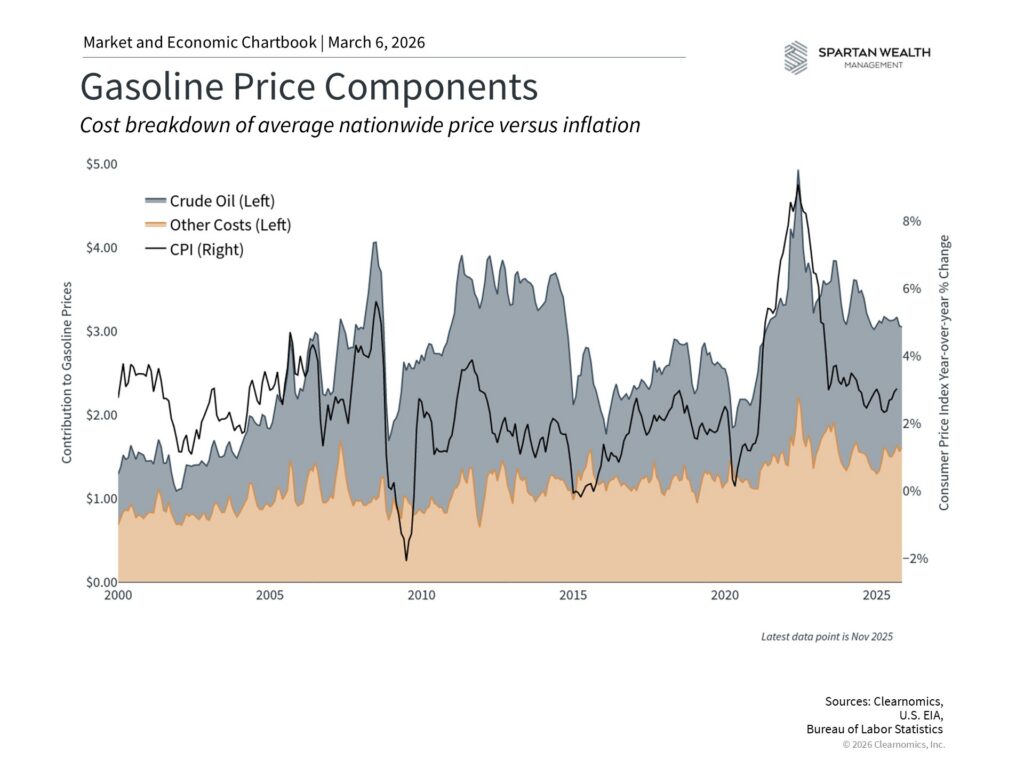
The included chart on historical gasoline price components is relevant here, since it shows how crude oil prices are the dominant driver of what consumers pay at the pump, making oil a key inflation and economic indicator.
While short-term oil price spikes can create economic headwinds, history shows that economies adapt over time, and keeping a long-term perspective is essential to navigating these periods of uncertainty.
Disclosure:
Advisors associated with Spartan Wealth Management may be either (1) registered representatives with, and securities offered through LPL Financial, Member FINRA/SIPC, and investment advisor representatives of Spartan Wealth Management; or (2) solely investment advisor representatives of Spartan Wealth Management, and not affiliated with LPL Financial. Investment advice offered through Spartan Wealth Management, a registered investment advisor and separate entity from LPL Financial.
Information presented is for educational purposes only and does not intend to make an offer or solicitation for the sale or purchase of any securities. Spartan Wealth’s website and its associated links offer news, commentary, and generalized research, not personalized investment advice. Nothing on this website should be interpreted to state or imply that past performance is an indication of future performance. All investments involve risk and unless otherwise stated, are not guaranteed. Be sure to consult with a tax professional before implementing any investment strategy. Investment Advisory Services offered through Spartan Wealth Management, a Registered Investment Advisor. Registration does not constitute an endorsement by the SEC nor does it imply a certain level of skill or training.
The information contained herein has been obtained from sources believed to be reliable, but is not necessarily complete and its accuracy cannot be guaranteed. No representation or warranty, express or implied, is made as to the fairness, accuracy, completeness, or correctness of the information and opinions contained herein. The views and the other information provided are subject to change without notice. All reports posted on or via www.clearnomics.com or any affiliated websites, applications, or services are issued without regard to the specific investment objectives, financial situation, or particular needs of any specific recipient and are not to be construed as a solicitation or an offer to buy or sell any securities or related financial instruments. Past performance is not necessarily a guide to future results. Company fundamentals and earnings may be mentioned occasionally, but should not be construed as a recommendation to buy, sell, or hold the company’s stock. Predictions, forecasts, and estimates for any and all markets should not be construed as recommendations to buy, sell, or hold any security–including mutual funds, futures contracts, and exchange traded funds, or any similar instruments. The text, images, and other materials contained or displayed in this report are proprietary to Clearnomics, Inc. and constitute valuable intellectual property. All unauthorized reproduction or other use of material from Clearnomics, Inc. shall be deemed willful infringement(s) of this copyright and other proprietary and intellectual property rights, including but not limited to, rights of privacy. Clearnomics, Inc. expressly reserves all rights in connection with its intellectual property, including without limitation the right to block the transfer of its products and services and/or to track usage thereof, through electronic tracking technology, and all other lawful means, now known or hereafter devised. Clearnomics, Inc. reserves the right, without further notice, to pursue to the fullest extent allowed by the law any and all criminal and civil remedies for the violation of its rights.